Back
Understand the TikTok Learning Phase in 2026, how it works, why it matters, and proven strategies to exit the learning phase faster and improve ad performance.
TikTok Ads
Are you running TikTok Ads but seeing unstable performance? One day your CPA looks great, the next day it spikes. Many advertisers assume something is wrong - but in reality, this is completely normal.
Understanding how the TikTok Learning Phase works is the difference between wasting budget and scaling profitable campaigns. In this guide, we’ll break down what it is, how it works, and how to pass it effectively in 2026.
What Is TikTok Learning Phase & How It Works

The TikTok Learning Phase is the period when TikTok’s algorithm collects data and identifies the best users for your campaign objective.
When you start running TikTok Ads, the system doesn’t immediately know who your ideal audience is. Instead, it enters a testing phase where it explores different audience segments, behaviors, and delivery patterns.
During this time:
Performance may fluctuate significantly
CPA, CPM, and CTR can be unstable
Delivery is continuously being adjusted
This is because TikTok relies heavily on user behavior signals. The algorithm needs enough data to understand:
Who is most likely to convert
What type of creatives work best
When and where to deliver your ads

How long does it last?
Typically, the TikTok Learning Phase lasts:
A few days to 7 days, or
Until the campaign reaches ~25–50 conversions
👉 In practice, achieving around 50 conversions is one of the strongest indicators that your campaign has successfully passed the learning phase. After this point, performance usually becomes more stable and predictable.
What triggers the Learning Phase?
Your campaign can enter (or re-enter) the Learning Phase when:
You launch a new campaign or ad group
You make significant budget changes
You adjust bid or ROAS targets
You change targeting settings
You switch bidding strategies
For example:
Increasing budget from $100 → $110: minor impact
Increasing budget from $100 → $300: major reset (back to learning)
This is why many advertisers get stuck - they unknowingly keep restarting the learning process.
Tips to Pass the Learning Phase
Passing the TikTok Learning Phase requires a balance of budget, patience, and strategy. Here are the most effective tactics used by agencies in 2026.

Start With the Right Budget
Budget is one of the biggest factors. Best practice: Start with ~30× your target CPA. This ensures TikTok has enough data to optimize delivery quickly. If your budget is too low, the system cannot exit the learning phase efficiently.
Set a Realistic Cost Cap
If you’re using Cost Cap bidding: Set it ~20–30% higher than your target CPA. Setting it too low restricts delivery and slows down learning.
Avoid Frequent Changes
Every major edit can reset the learning phase. Avoid:
Constant budget edits
Changing creatives too frequently
Adjusting targeting daily
Instead:
Make small changes
Wait at least 24 hours between optimizations
Don’t Pause Campaigns Too Early
Pausing campaigns during the learning phase interrupts data collection. Let your campaign run long enough to:
Gather meaningful data
Allow the algorithm to stabilize
Test Smart, Not Random
Testing is essential when running TikTok Ads, but structure matters. Focus on testing:
Different creatives (hooks, formats, styles)
Broad vs interest targeting
Before launching any campaign, make sure you’re fully prepared by mastering the critical things before running TikTok Ads.
Be Patient
This is the most underrated factor. TikTok Ads is not a “set and win instantly” platform. The algorithm improves over time — but only if you give it enough data and consistency.
Why Campaigns Fail During TikTok Learning Phase (And How to Fix Them)
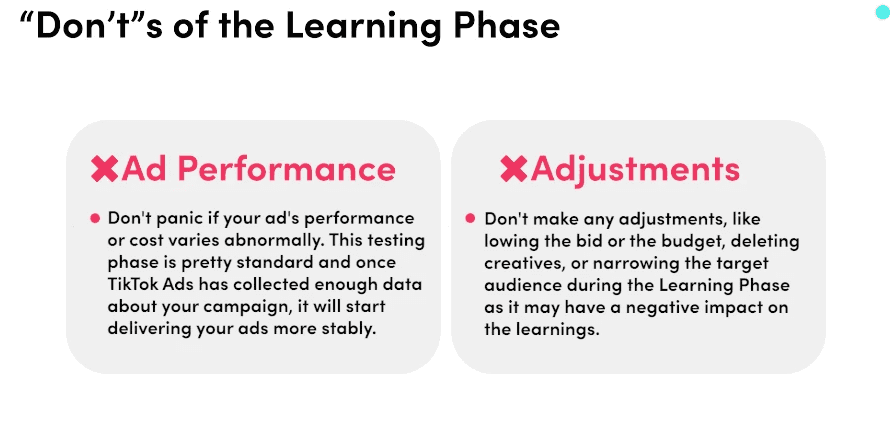
Many advertisers struggle with TikTok Ads not because the platform doesn’t work - but because they mishandle the learning phase. Here are the most common mistakes and how to fix them.
Budget Too Low
Problem: If your budget is too small, TikTok doesn’t get enough data to optimize delivery. As a result, your campaign stays in the learning phase longer and performance remains inconsistent.
Fix: Start with a budget of at least 30× your target CPA. This gives the algorithm enough room to test, learn, and stabilize faster.
Not Competitive Enough
Problem: TikTok Ads operates in an auction system. If your ads are not competitive compared to others targeting the same audience, your campaign may struggle to win impressions - which means fewer conversions and slower learning.
Fix: To improve competitiveness:
Broaden your targeting to give the system more flexibility
Increase your bid or cost cap to stay competitive in auctions
Improve your creatives (stronger hook, better visuals, clearer message)
Over-Optimization
Problem: Making too many changes too quickly (budget, targeting, creatives) resets the learning phase repeatedly. This prevents the algorithm from ever stabilizing.
Fix:
Avoid frequent edits
Let campaigns run for at least 24 - 48 hours before making decisions
Focus on small, controlled optimizations instead of constant changes
Unrealistic Cost Cap
Problem: Setting your cost cap too low restricts delivery. TikTok cannot find enough users within that constraint, which slows down or blocks the learning process.
Fix: Set your cost cap 20–30% higher than your target CPA to give the system more flexibility during optimization.
Poor Creative Volume
Problem: If you only run 1–2 creatives, TikTok has limited data to test what works best. This reduces optimization efficiency and slows down learning.
Fix: Provide multiple creatives with different angles, hooks, and formats so the algorithm can identify winning patterns faster. For more creative tips, read our article on optimizing TikTok ad creatives.
Pausing Too Early
Problem: Stopping campaigns too soon interrupts the learning process before enough data is collected. This means your campaign never reaches stable performance.
Fix: Let your campaign run until:
It reaches a sufficient number of conversions (ideally ~50 conversions)
Performance starts to stabilize
Large Budget Changes
Problem: Sudden budget increases force TikTok to find a completely new audience pool, which can reset the learning phase.
Fix: Scale gradually by increasing budget in steps of 20–30% instead of making large jumps.
Conclusion
Success with TikTok Ads comes down to how well you manage the Learning Phase. Most campaigns fail because they don’t give the algorithm enough data and structure to learn properly. That’s where experience makes the difference.
At Ecomdy Media, we help brands set up, optimize, and scale TikTok Ads effectively - guiding campaigns through the Learning Phase to turn unstable performance into predictable growth. Contact our team now!